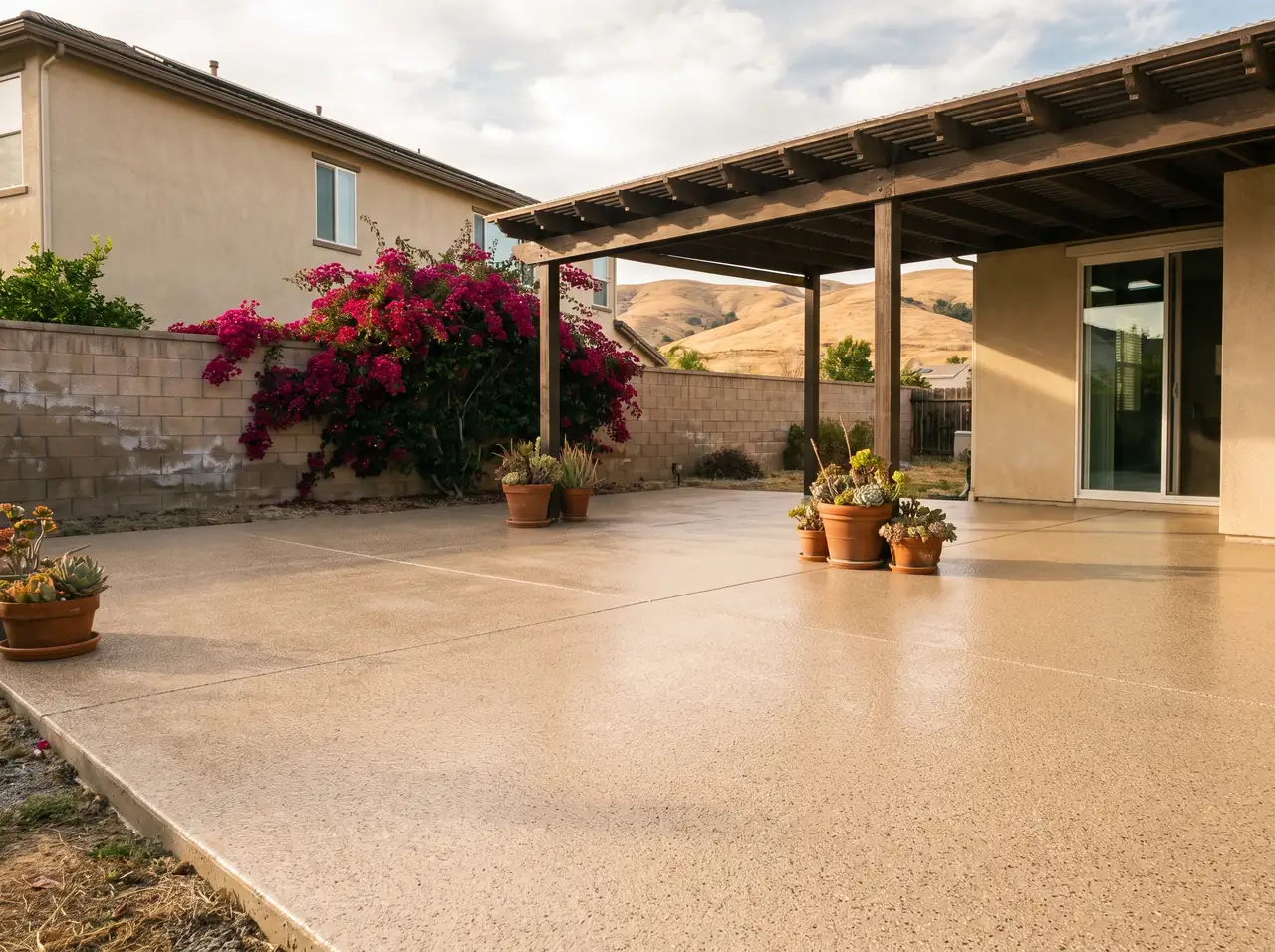
Polyaspartic flake coatings for patios, entries and walkways that hold their color in full sun and give your feet some grip.
Call Now for a Free EstimateTell us about the floor and we’ll call you back the same working day.
Prefer to talk? Call (619) 815-7296
Patio coatings in Chula Vista give tired outdoor concrete a clean, textured finish that stands up to year-round sun. We coat back patios, front entries, walkways and side yards with polyaspartic systems, which stay color-stable outdoors where standard epoxy would yellow.
The slab is cleaned and diamond-ground to remove dirt, old paint and sealers. Cracks are repaired, and saw-cut control joints are kept open so the slab can still move with the seasons.
A polyaspartic base coat goes down with a broadcast of flakes in sand, stone or gray tones. A clear polyaspartic topcoat with anti-slip grit seals it. Most patios are done in a day or two.
People call when deck paint is peeling, when rust, fertilizer or barbecue stains won’t come out, or when an old slab looks worn next to new landscaping. A coating is also a good finishing step before adding an outdoor kitchen or new patio furniture.
Landlords and sellers often coat patios and entries as a quick way to freshen a property before photos.
The biggest reason is sunlight. Standard epoxy breaks down under UV light, turning amber and chalky, which is why it belongs indoors. Thin patio paints sit on top of the concrete and peel once water gets under them.
Moisture is the other cause. Many patios were poured without a vapor barrier, so ground moisture moves up through the slab. A breathable approach and proper grinding keep the coating attached.
Every outdoor slab is quoted after we see it. Book a free estimate and we’ll bring flake samples.
| Polyaspartic | Standard epoxy | |
|---|---|---|
| Sun exposure | Stays clear and color-stable | Yellows and chalks in direct sun |
| Cure time | Fast; often walkable next day | Slower |
| Best for | Open patios, entries, walkways | Covered or indoor slabs only |
| Flexibility | More flexible with temperature swings | More rigid |
For any slab that sees direct sun, polyaspartic is the right call. For floors inside the garage, see garage floor epoxy.
Any surface in direct sun warms up, and darker colors get hotter than lighter ones. Light sand, beige and stone flake blends stay noticeably cooler underfoot, so those are the usual picks for open patios.
A flake coating has natural texture, and an anti-slip grit is added to the topcoat on outdoor floors. That gives better footing when sprinklers or rain wet the surface.
Polyaspartic cures quickly, so most patios are ready for foot traffic the next day. Furniture and grills can usually go back a day or two after that.
Standard epoxy is not UV-stable. In direct sun it turns yellow or amber and can get a chalky surface within months. Polyaspartic keeps its color, which is why it is the go-to for outdoor concrete.
Call for a free on-site estimate and see flake samples in person.
Call (619) 815-7296 for a Free Estimate Request an Estimate Online