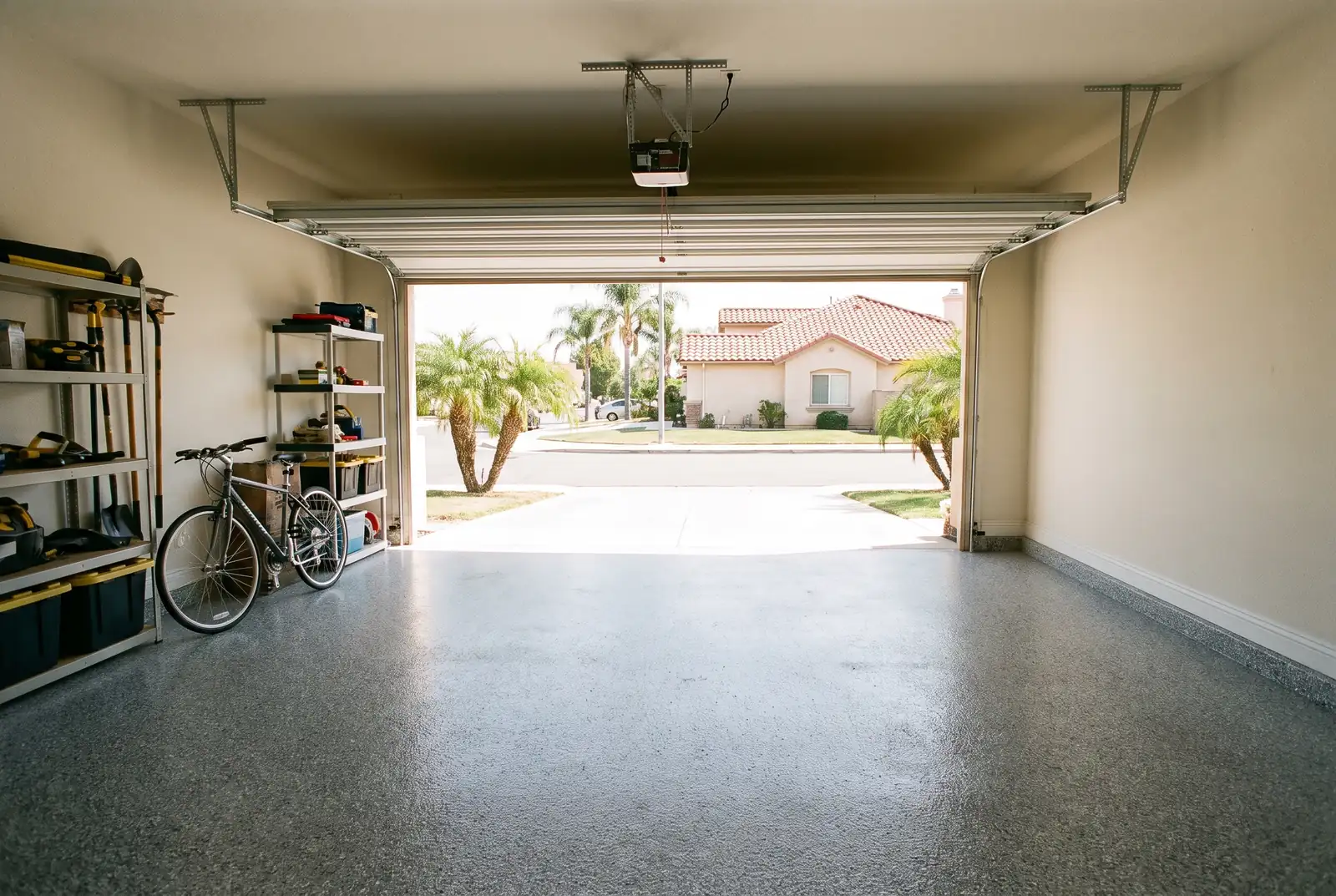
A full flake system over a diamond-ground slab, sealed with a clear topcoat that shrugs off hot tires, oil drips and the sun coming through the garage door.
Call Now for a Free EstimateTell us about the floor and we’ll call you back the same working day.
Prefer to talk? Call (619) 815-7296
Garage floor epoxy in Chula Vista turns a dusty, stained slab into a sealed floor you can sweep, hose off and park on. We install flake systems in one-, two- and three-car garages from Eastlake to the west side, and every floor is diamond-ground first so the coating bonds for the long haul.
A garage floor epoxy install is a layered system, not a single coat of paint. The crew grinds the slab, vacuums it, repairs cracks and chips, rolls a base coat and broadcasts vinyl color flakes until the base is fully covered.
Once the base cures, loose flakes are scraped and vacuumed off, and a clear polyaspartic topcoat seals the surface. That topcoat is what you actually drive on, and it’s what keeps the floor glossy and easy to clean.
Most two-car garages take one to two days on site. Foot traffic is fine the next day, and cars can usually go back in after a few days.
The most common trigger is an old coating peeling in the tire paths. Others are oil and fluid stains that won’t scrub out, concrete dust on everything stored in the garage, and a floor that looks rough next to a remodeled house.
White powder or crusty patches on the slab, called efflorescence, are worth mentioning at the estimate. They point to moisture moving up through the concrete, which changes which primer the floor needs.
A new floor also makes sense before turning the garage into a gym, a workshop or a place the kids hang out.
Garage floor coatings usually peel for one of three reasons. The concrete was never ground, so the coating sat on a smooth, sealed surface with nothing to grip. The product was a thin one-part paint that softens under hot tires. Or moisture pushing up from under the slab broke the bond from below.
Hot tire pickup is the version most people see: tires come in warm after a drive, soften a weak coating and pull it up when the car leaves. A ground slab, a two-part base coat and a hard topcoat prevent it.
Every garage is quoted in person, and the estimate is free. Book a free on-site estimate and you’ll get a written quote before anything is scheduled.
| Epoxy base + polyaspartic topcoat | Full polyaspartic system | |
|---|---|---|
| How it works | Epoxy base coat soaks into the ground slab; polyaspartic topcoat seals it | Polyaspartic used for every layer |
| Install time | Usually two days on site | Often finished in a single day |
| Best for | Slabs with more repair, texture or minor moisture | Sound slabs where a fast turnaround matters |
| UV stability | Topcoat is UV-stable | Every layer is UV-stable |
Both systems give you the same look and a hard, clear wear surface. The right pick depends on the slab and your schedule, and we’ll recommend one at the estimate after checking the concrete.
Yes, the floor needs to be completely clear, including shelving that sits on the slab. Most people move things to the driveway or a side yard for the day or two the crew is working. Wall-mounted cabinets and anything hanging can stay.
Cracks are filled and ground flush before coating, and a full flake broadcast does a good job of disguising them. A repaired crack can still show as a faint line, and if the slab keeps moving the line can reappear over time.
Not when the slab has been diamond-ground and the system is a two-part base coat with a polyaspartic topcoat. Hot tire pickup happens with thin one-part paints and coatings rolled onto unground or etched concrete.
Yes. The short concrete curb along the garage walls, called the stem wall, can be coated with the same flake system for a finished edge. It also keeps water and dirt off the drywall seam.
Call for a free on-site garage floor estimate.
Call (619) 815-7296 for a Free Estimate Request an Estimate Online